
Gate 1 — See the Frame: Read Korean Blocks Before You Learn a Single Letter
 5 min read
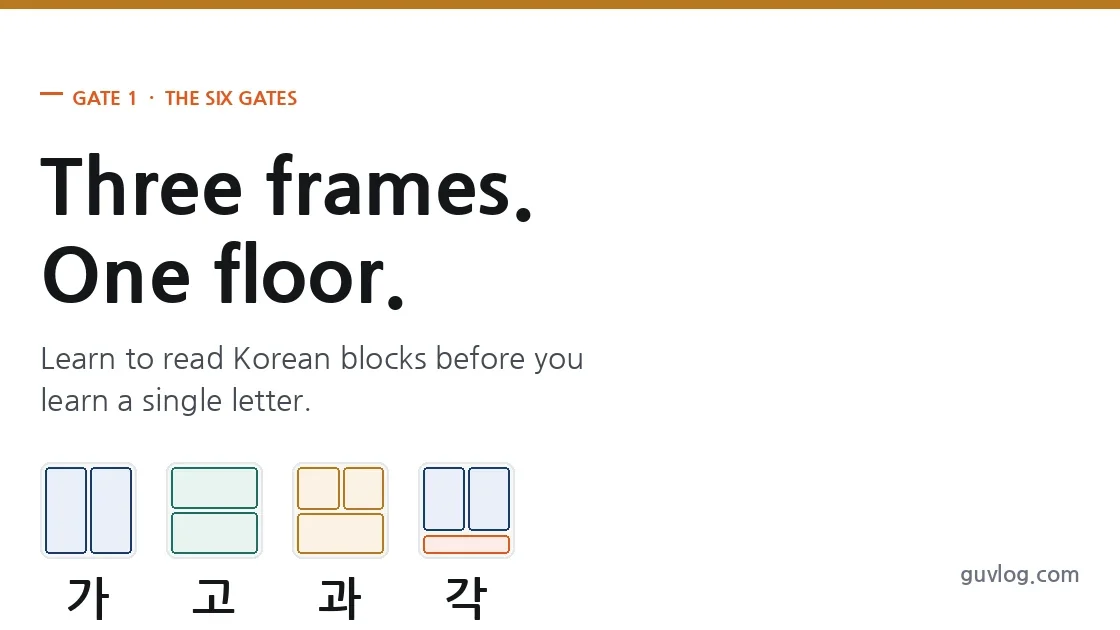

This is Gate 1 of the Six Gates, a mastery-gated system for learning to read Korean. You do not move to Gate 2 until you pass this one.
Here is the unusual part: you will not learn a single letter in this gate. Not one. That is deliberate.
Korean is not read letter by letter. It is read block by block, and your eye has to learn the shape of a block before your brain can decode what is inside it. Skip this and you will spend months reading at the speed of a five-year-old, assembling every syllable from parts. Spend forty minutes here and the assembly step never forms as a habit in the first place.
What this gate trains
One skill: seeing structure at a glance.
By the end you will be able to look at a Korean word you have never seen, instantly know how many syllables it has, and know where each letter slot sits inside every block — without knowing what any of it says.
That sounds like a party trick. It is actually the load-bearing skill. Every later gate stacks on it.
Every Korean syllable is a frame
A Korean syllable block is a square of fixed size. Two letters or four, the square stays the same width. What changes is how the letters are arranged inside it — and there are only three arrangements.

Frame 1 — Side
The second letter stands to the right of the first. The block splits vertically, like two columns.
가 너 미 사 이 대
Look at the seam. It runs top to bottom, down the middle. Anything that splits left-and-right is a Side frame.
Frame 2 — Stack
The second letter sits underneath the first. The block splits horizontally, like two rows.
고 누 므 소 우 츠 표
The seam runs left to right, across the middle. Anything that splits top-and-bottom is a Stack frame.
Frame 3 — Wrap
The second part does both — it runs down the right side and along the bottom, wrapping around the first letter.
과 워 위 의 왜 뒤 회
These look busier than the other two, and that busyness is the tell. If a block feels crowded in the bottom-right, it is a Wrap.
And some frames have a floor
Any of the three frames can carry an extra letter along the bottom edge. Korean calls it 받침 (batchim), which literally means support or prop. Think of it as a floor the frame stands on.

Three frames, floor or no floor. Six possibilities, and that is the entire structural grammar of written Korean. There is no seventh case waiting to ambush you later.

Occasionally a floor holds two letters instead of one — 닭, 앉, 값. Those are rare and they behave the same way structurally. For Gate 1, a floor is a floor.
Why this beats learning the letters first
Give a beginner who has memorised all twenty-four letters the word 놀이공원 and watch what happens. They stop. They point at the first block. They say the first letter, then the second, then the third, then push them together. Four blocks, roughly twelve seconds.
Now give the same word to someone who has passed this gate. They see four squares before they read anything. The word has already been chunked. Decoding happens inside a structure their eye has already resolved.

That is the whole difference between reading and decoding, and it is available for the price of about forty minutes.
The drill
Twenty blocks. Pick the frame, and say whether it has a floor. The timer starts on your first answer and your best run is saved in this browser.
Do not try to read anything. Do not sound anything out. You are only looking at where the seams are.
Pass mark: 19 of 20 correct in under 60 seconds. Your record is stored in this browser only — nothing is sent anywhere, and there is no account to make.
The pass mark
19 of 20 correct, under 60 seconds, on the Frame drill.
Most people clear it on the third or fourth attempt. If you are stuck under 15 correct, you are almost certainly trying to read the blocks instead of looking at them. Unfocus your eyes slightly. You are looking for seams, not sounds.
The second tab, Count the blocks, uses real Korean words. It is not part of the pass condition, but if you can count blocks in an unfamiliar word without hesitating, you have the skill this gate exists to build.
Three mistakes that cost people time here
- Trying to learn the letters at the same time. You will meet them in Gate 2, in an order chosen for usefulness rather than alphabetical accident. Learning them now, out of order and without words attached, is wasted effort you will have to redo.
- Treating Wrap as a special case. It is not rare. Wrap frames appear in 왜, 위, 의, 원, 과 — some of the most common syllables in the language. Give them equal drill time.
- Deciding the gate is too easy and skipping ahead. Easy is the point. The skill is cheap to acquire and expensive to skip. Every learner who plateaus at slow reading skipped this.
What Gate 2 does with this
Gate 2 is called The First Forty. You will learn only the letters needed to read forty real, high-frequency Korean words — not the alphabet in order, not letter charts. Because you already see frames, those forty words will land as shapes rather than as puzzles.
Pass this gate first. The system only works if the gates stay closed.
Keep reading
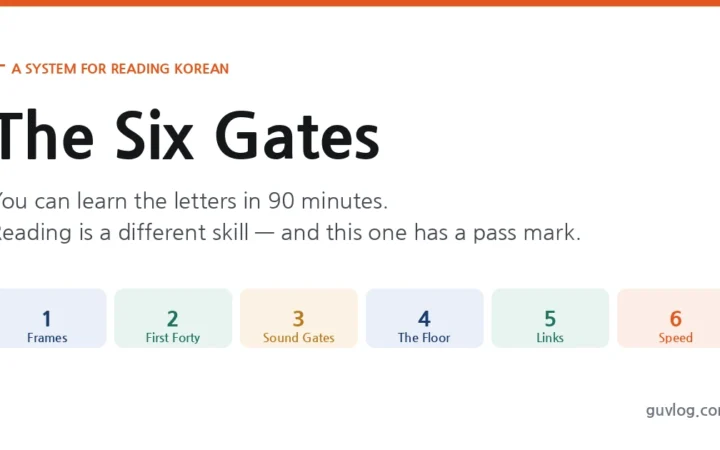
How to Learn Hangul: The Six Gates Method
You can learn the Korean letters in ninety minutes. That claim gets repeated everywhere, and it is true. It is also the…